Wednesday, 8 October 2025
We were up early again this morning but not quite as early as the last two days. After a quick breakfast, we had the car re-packed before 8.00am and drove out to Katiki Point to see the lighthouse and look for the yellow-eyed penguins. The lighthouse was accessible BUT fenced off, so a little bit difficult to photograph. We love a good lighthouse and it was a bit disappointing that we couldn’t take a decent photo. Then we set off on one of our Gaffney wild goose chases, although we were actually chasing the yellow-eyed penguins.
We set out along the designated path, peering over the edge whenever possible, looking for wildlife on the small beaches below us. We could see New Zealand fur seals down on the beaches but no penguins. We continued along the path until we reached a narrower section, where we encountered fur seals hauled out way above the beach on the grass. These seals were a long way above the water! We didn’t want to disturb them so walked quietly between seals sleeping on both sides of the path. They could not have cared less, barely cracking an eyelid to watch the humans go by.
At the end of the point we found ourselves looking over one final rocky outcrop that was covered in red-beaked gulls. Judging by the warning signs about the potential to be cut off by the incoming tide, people do venture over onto this lump of rock. We knew the tide was still going out but the rock hopping needed to get over to the outcrop looked a bit too dicey for us. And besides, it did not seem a particularly good idea to disturb all those gulls. Imagine hundreds of gulls wheeling above us doing what gulls do from a great height over unsuspecting humans??!
We decided to head back towards the beach areas, feeling they were the most likely place to see the penguins … unless there was a lovely sandy beach on the other side of the rocky outcrop where they were hiding out? Returning to the section of path bordered with a substantial palisade fence, we felt we were probably in the right zone to glimpse the penguins … if there were any about this morning. Nope, still just the same fur seals lounging about.
While we waited we saw a ranger coming along the path. She collected some temporary fence spikes and tape and continued towards us. We greeted her and asked about the penguins. We had read that these guys are rare but had no idea how rare. The ranger told us that they are beyond rare and basically heading for extinction rapidly. Katiki Point is the largest breeding colony in the world and there are only 16 breeding pairs this year, down from 21 breeding pairs last year. I asked why they fair less well than the little blue penguins and we were told that one of their biggest problems is that they are bottom feeders rather than pelagic feeders and there is more garbage on the sea bed so finding food is a big problem for them.
The ranger then took us back out along the track to a point where we could see the next beach back towards the lighthouse behind the beach that we had been staring at. She told us that if there were any penguins active this morning this is where we would see them. Despite watching the small stretch of sand intently for about 45 minutes we were unable to spot any penguins.
About quarter past nine we decided we should head to our next stop, the Moeraki Boulders. As we returned along the path we saw a keen photographer balanced on a fence post trying to take a photo of the lighthouse over the top of the fence with her DSLR. We had settled for taking photos with our phones held above the fence line. We were pretty satisfied with those photos and … we didn’t risk falling from a rickety old fence post!
It was only a short drive to the boulders, where we parked the car in the cafe car park and headed down to the beach to find the boulders well exposed at low tide. I thought that I had looked at a photo of the Moeraki Boulders but I was wrong, because the boulders were quite different from what I was expecting. I thought they were smaller and more densely packed on the beach. What we encountered was a collection of mysterious, very large spherical stones that are scattered across the beach in varying stages of erosion.
The most complete are still perfectly spherical and weigh several tonnes. Others look like hatching eggs and some are like eggshell fragments scattered on the sand. The boulders are described by scientists as calcite concretions that were formed about 65 million years ago. Maori legends say the boulders are gourds washed ashore from the great voyaging canoe Araiteura when it was wrecked upon landfall in New Zealand hundreds of years ago. Very enigmatic.
After drinks and a toilet stop at the Moeraki Boulders Cafe, we set the SatNav for Olveston Historic Home in Dunedin. The home was designed by acclaimed English architect Sir Ernest George and built for Dunedin businessman, collector and philanthropist David Theomin, his wife Marie and their two children Edward and Dorothy early in the 20th century. It was occupied by the family from 1906 and gifted, along with its contents, to Dunedin City Council when the last remaining member of the family, Dorothy, died childless in 1966. We took a guided tour of the home and found it to be every bit as impressive as a National Trust property in the UK.
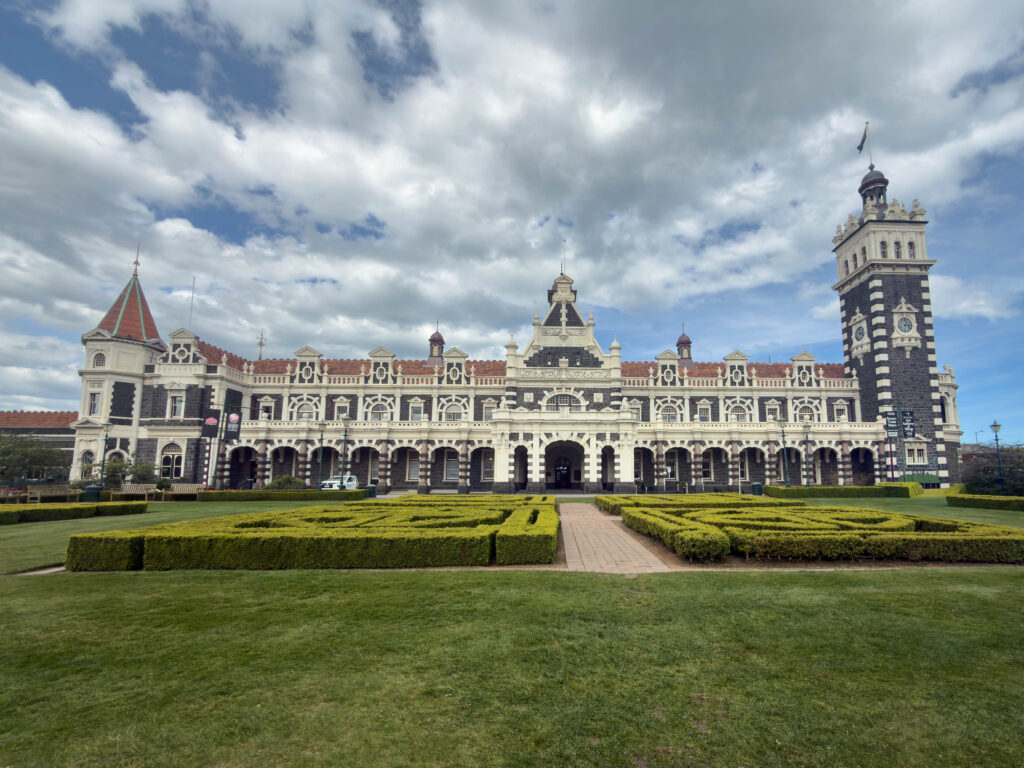
Our next stop was lunch at the Iconic Cafe opposite Dunedin Station that was recommended by our guide. I had a delicious bowl of seafood chowder while Bernie settled for a giant sausage roll. We wandered over to the station where our photography efforts were hampered by gardeners and Chinese tourists. The gardeners were taking out the spring flower display from the garden beds, which obviously needs to be done, but their work vehicles were parked EVERYWHERE. The group of Chinese tourists were hogging the entire platform trying to take the perfect shot. The subject of the shot kept rejecting the photos being taken, so her photographer had to try again and again and AGAIN to take a photo that would satisfy her exacting requirements. Meanwhile we were not the only other photographers waiting patiently to take a photo of the Dunedin Station sign with the vintage train behind it!!
We took a stroll up around The Octagon precinct of the city where we found Town Hall shrouded in scaffolding and shade cloth, the imposing St Paul’s (Anglican) Cathedral and Robert Burn’s statue. We returned to the station via the First Church of Otago, a massive Presbyterian church built in the 1800s in the gothic style. It boasts an impressively soaring, gabled steeple!
We drove to the Botanic Gardens where we walked around the flat part. The gardens are expansive and continue up a steep slope that I just didn’t have the energy for this afternoon! I am still jet-lagged. At least I hope it’s just a bit of jet lag and I’ll feel more energetic soon because this afternoon I hit the wall and was very, very tired.
Before driving to the Aurora on George, we made a brief stop at Baldwin Street, renowned as the steepest street in the world. Officially! Bernie has just told me that it’s recognised as such in the Guinness Book of Records so … you can’t argue with that. It was certainly steep and I doubt that I would consider attempting to walk up it … even on a good day.
Arriving at our motel I flaked out on the bed with my book until dinner time. When it was time to eat we ventured as far as Buddha Stix, an Asian fusion restaurant located on site.
Steps: 12,083 (7.85kms)